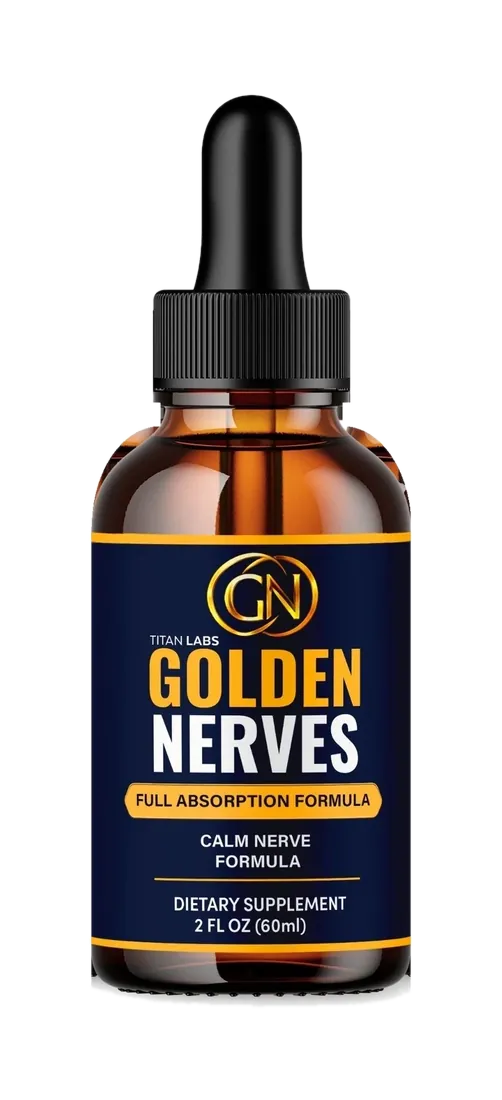
Read from the Supplement Facts panel
Golden Nerves Ingredients: All Six Extracts on the Label
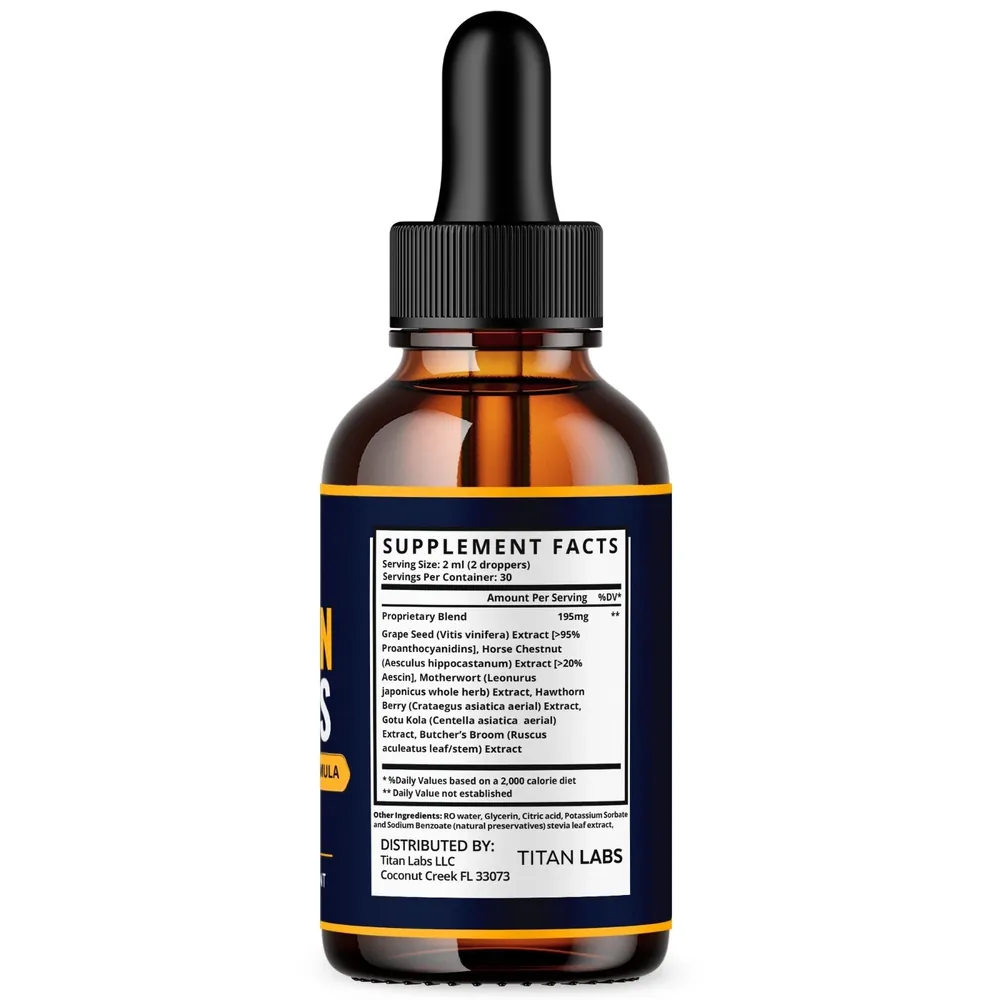
Golden Nerves has six plant extracts in a 195 mg proprietary blend per 2 ml serving: grape seed (>95% proanthocyanidins), horse chestnut (>20% aescin), motherwort, hawthorn berry, gotu kola and butcher's broom. The label does not publish how much of each extract is in the blend, so each is likely below the amounts used in research.
What is in Golden Nerves?
Golden Nerves contains six plant extracts in one 195 mg proprietary blend. Each 2 ml serving also carries water, glycerin, a little citric acid, two preservatives and stevia for taste.
The six extracts are grape seed, horse chestnut, motherwort, hawthorn berry, gotu kola and butcher's broom. That is the order on the Supplement Facts panel. Only two of them carry a standardization number. The label gives one total weight for all six, not a weight for each.
The six extracts at a glance
The table lines up all six extracts side by side. Read the last two columns together: studied amounts are known, but the Golden Nerves amounts are not.
| Extract (as printed) | Plant part | Standardized to | Main research area | Studied daily amount | Amount in Golden Nerves |
|---|---|---|---|---|---|
| Grape Seed (Vitis vinifera) | Seed | >95% proanthocyanidins | Blood pressure, heart markers | Low hundreds of mg up to 2,000 mg | Not published |
| Horse Chestnut (Aesculus hippocastanum) | Seed | >20% aescin | Leg vein comfort (CVI) | About 100–150 mg aescin | Not published |
| Motherwort (Leonurus japonicus) | Whole herb | Not stated | Traditional calming use, lab work | No clear human dose | Not published |
| Hawthorn Berry (Crataegus asiatica) | Aerial parts | Not stated | Heart | A few hundred mg or more | Not published |
| Gotu Kola (Centella asiatica) | Aerial parts | Not stated | Leg vein comfort (CVI) | 60–180 mg triterpene fraction | Not published |
| Butcher's Broom (Ruscus aculeatus) | Leaf and stem | Not stated | Leg vein comfort (CVI) | Standardized preparation, twice daily | Not published |
"CVI" means chronic venous insufficiency. It is a medical condition of the leg veins. Much of the research on these plants was done in people with that condition.
Each extract, one by one
Each profile covers the plant, its standardization, the research and the studied amount. The grape seed fact sheet from NCCIH is a good plain-English start.
1. Grape Seed Extract (Vitis vinifera)
What it is: an extract of the seeds of wine grapes. It is rich in proanthocyanidins, a family of plant polyphenols.
Standardization: the label prints ">95% Proanthocyanidins." That is a high purity figure for this group of compounds.
What research looked at: mostly blood pressure and heart health markers. A meta-analysis of 16 trials pooled blood pressure results (Zhang et al., 2016). An earlier review looked at wider heart risk markers (Feringa et al., 2011).
Studied amount vs. the bottle: trials used from the low hundreds of milligrams up to 2,000 mg a day. The Golden Nerves amount is not published. The whole blend is 195 mg.
2. Horse Chestnut Extract (Aesculus hippocastanum)
What it is: an extract of the seed of the horse chestnut tree. Raw seeds, bark and leaves are unsafe to eat. Supplements use a processed seed extract instead (NCCIH).
Standardization: ">20% Aescin." Aescin is the compound most studied in this plant.
What research looked at: leg swelling and leg vein comfort in people with CVI. A Cochrane review pooled those trials (Pittler & Ernst, 2012).
Studied amount vs. the bottle: most trials gave about 100–150 mg of aescin a day. Here is the math for Golden Nerves. Suppose all 195 mg were horse chestnut at 20% aescin. That comes to about 39 mg of aescin. In reality the blend is shared six ways, so it is less.
3. Motherwort Extract (Leonurus japonicus)
What it is: a mint-family herb. It has a long history in traditional Chinese herbal practice. The label lists the whole herb.
Standardization: none printed.
What research looked at: mostly lab and animal work. A large review of Leonurus japonicus covers its traditional uses and plant chemistry (Shang et al., 2014). A related species, Leonurus cardiaca, is known in Europe as a traditional calming herb (Wojtyniak et al., 2013).
Studied amount vs. the bottle: there is no well-tested human dose to compare. Of the six, motherwort has the thinnest human evidence.
4. Hawthorn Berry Extract (Crataegus asiatica)
What it is: an extract from a hawthorn shrub. The label names it "Hawthorn Berry" and lists "aerial" parts, meaning parts that grow above ground.
Standardization: none printed.
What research looked at: mostly the heart. NCCIH calls the human evidence limited (NCCIH).
Studied amount vs. the bottle: trials usually used standardized extracts at a few hundred milligrams a day or more. The Golden Nerves amount is not published.
A buying note: NCCIH reports a 2024 FDA warning about fake "hawthorn" or "tejocote" products that held toxic yellow oleander. Buy only sealed, labeled bottles from the authorized seller.
5. Gotu Kola Extract (Centella asiatica)
What it is: a low, creeping herb from wet parts of Asia. It is common in Ayurvedic and Southeast Asian traditions.
Standardization: none printed. The label lists aerial parts.
What research looked at: signs of CVI, such as leg heaviness and swelling. A systematic review summed up those trials (Chong & Aziz, 2013).
Studied amount vs. the bottle: trials commonly used 60–180 mg a day of a purified triterpene fraction. That is a concentrate, not a plain herb extract. The Golden Nerves amount is not published.
6. Butcher's Broom Extract (Ruscus aculeatus)
What it is: a small, spiky evergreen shrub from Europe. The label lists leaf and stem.
Standardization: none printed.
What research looked at: leg comfort in CVI. One 12-week placebo-controlled trial used a standardized preparation twice a day (Vanscheidt et al., 2002). A Cochrane review groups butcher's broom with other "phlebotonics," or vein-toning plant products (Martinez-Zapata et al., 2020).
Studied amount vs. the bottle: the trial product was a specific branded preparation. The Golden Nerves amount is not published.
Are the Golden Nerves doses the same as in studies?
Almost certainly not. Every extract here is likely below the amount used in its own research.
Start with the total
The label prints 195 mg for all six extracts together.
Divide it
Six extracts share that total. The average share is about 32 mg each.
Compare
Studied amounts run from about 60 mg to 2,000 mg a day, and horse chestnut needs 100–150 mg of aescin alone.
Conclude
The blend is a small, mixed dose. It is not a copy of any clinical trial.
This does not mean the product is empty. It means research on single, high-dose extracts does not tell you what this blend will do. For more on reading a blend, see how to read a proprietary blend label.
What the research on these plants is really about
Four of the six extracts are studied mainly for leg veins and circulation. One is studied mainly for the heart. One is a traditional calming herb.
Leg vein group
Horse chestnut, gotu kola, butcher's broom and, in part, grape seed. Trials mostly enrolled people with CVI.
Heart group
Hawthorn. Human evidence is limited, per NCCIH.
Calming tradition
Motherwort. Mostly lab and animal data so far.
Studies done in people with a medical condition do not show what happens in healthy adults. Keep that in mind when you read about any of these plants. How Golden Nerves works covers this in more detail.
The label also has no B vitamins, no alpha-lipoic acid and no other classic "nerve nutrients." It is a plant-only formula.
What else is in the bottle?
The other ingredients are the liquid base and the helpers that keep it stable. The label lists: RO water, glycerin, citric acid, potassium sorbate and sodium benzoate (natural preservatives), stevia leaf extract.
- RO water: water cleaned by reverse osmosis. It is the main liquid.
- Glycerin: a thick, sweet liquid that carries plant extracts.
- Citric acid: adjusts tartness and acidity.
- Potassium sorbate and sodium benzoate: preservatives that slow mold and yeast.
- Stevia leaf extract: a sweetener with almost no calories.
No alcohol is listed.
Who should check the ingredient list with a clinician?
Anyone who takes a prescription medicine should. Several of these plants may interact with common drugs.
Golden Nerves is for adults 18 and older. It is not for use during pregnancy or breastfeeding. See side effects and cautions for the full list.
Golden Nerves ingredients: common questions
How many ingredients are in Golden Nerves?
Six active plant extracts, plus water, glycerin, citric acid, two preservatives and stevia. The six extracts share one 195 mg blend.
Which Golden Nerves ingredients are standardized?
Two. Grape seed is standardized to more than 95% proanthocyanidins. Horse chestnut is standardized to more than 20% aescin. The other four have no standardization on the label.
How much horse chestnut is in each serving?
The label does not say. Even if the whole 195 mg blend were horse chestnut, it would give about 39 mg of aescin. Trials mostly used 100–150 mg of aescin a day.
Does Golden Nerves contain alcohol?
No alcohol is listed. The base is RO water and glycerin.
Are there vitamins in Golden Nerves?
No. The label lists no vitamins or minerals. It is a plant-extract formula only.
Why is the amount of each extract not listed?
A proprietary blend only has to show the total weight. The maker has not published the split, and we do not guess it.
Sources for this page
- Zhang H, et al. The impact of grape seed extract treatment on blood pressure changes: a meta-analysis of 16 randomized controlled trials. Medicine (Baltimore), 2016. Source
- Feringa HH, et al. The effect of grape seed extract on cardiovascular risk markers: a meta-analysis of randomized controlled trials. J Am Diet Assoc, 2011. Source
- Pittler MH, Ernst E. Horse chestnut seed extract for chronic venous insufficiency. Cochrane Database of Systematic Reviews, 2012. Source
- National Center for Complementary and Integrative Health. Horse Chestnut. Updated April 2025. Source
- Shang X, et al. Leonurus japonicus Houtt.: ethnopharmacology, phytochemistry and pharmacology of an important traditional Chinese medicine. J Ethnopharmacol, 2014. Source
- Wojtyniak K, Szymański M, Matławska I. Leonurus cardiaca L. (motherwort): a review of its phytochemistry and pharmacology. Phytother Res, 2013. Source
- National Center for Complementary and Integrative Health. Hawthorn. Updated April 2025. Source
- Chong NJ, Aziz Z. A systematic review of the efficacy of Centella asiatica for improvement of the signs and symptoms of chronic venous insufficiency. Evid Based Complement Alternat Med, 2013. Source
- Vanscheidt W, et al. Efficacy and safety of a Butcher's broom preparation (Ruscus aculeatus L. extract) compared to placebo in patients suffering from chronic venous insufficiency. Arzneimittelforschung, 2002. Source
- Martinez-Zapata MJ, et al. Phlebotonics for venous insufficiency. Cochrane Database of Systematic Reviews, 2020. Source
- National Center for Complementary and Integrative Health. Grape Seed Extract. Updated February 2025. Source
Keep reading
Ready when you are
Order Golden Nerves from the authorized US retailer
30 servings in every 2 fl oz bottle. 60-day money-back guarantee. A real person at +1 (302) 200-3480 for orders, tracking and refunds.